 Add to Chrome
 Add to Firefox
 Add to Edge
TAP-JEPA: Frozen Future-Latent Probing and Two-Stage Score Fusion for EPIC-KITCHENS-100 Action Anticipation
May 30, 2026
This report presents TAP-JEPA, our runner-up submission to the EPIC-KITCHENS-100 (EK-100) Action Anticipation Challenge at EgoVis 2026. The task is to anticipate the next verb, noun, and verb-noun action from an egocentric clip that ends before the target action begins. Instead of fine-tuning a large video backbone, TAP-JEPA builds a compact anticipation model on frozen V-JEPA 2.1 features: a ViT-G/384 encoder extracts visible pre-action tokens, the pre-trained latent predictor estimates near-future tokens from the observed context, and both token groups are fused by attentive probes with task-specific queries for verbs, nouns, and action pairs. For the final submission, we expand supervised training with the official training split and most of the validation split, reserving a small subset for sanity checks and qualitative inspection, and adopt a two-stage score fusion that first averages eight independently initialized probe replicas within each epoch and then merges candidates from epochs 12-20 with field-dependent weights. On the official open-testing leaderboard, our sunshinesky entry achieves 27.91 percent overall action Mean Top-5 Recall (MT5R), ranking second and only 0.04 percentage points behind the top score.

FROST-STA: Frozen Dense Features for the Ego4D Short-Term Object Interaction Anticipation
May 30, 2026Short-term anticipation in egocentric video requires more than recognizing the current scene: a system must infer which object the camera wearer will contact, which action will follow, and how soon the contact will happen. This report describes FROST-STA, our submission to the Ego4D Short-Term Object Interaction Anticipation (STA) Challenge at EgoVis 2026. For each query time, the model produces a ranked set of structured hypotheses containing an active-object box, noun label, verb label, time-to-contact (TTC), and confidence. FROST-STA builds on the V-JEPA 2.1 STA evaluation protocol, but adapts it to the challenge by using object-centric decoding, multi-head prediction, and a submission-oriented training and ensembling recipe. We keep the V-JEPA 2.1 ViT-G backbone fixed and extract two dense token streams: video tokens from a short clip resized to 384 pixels before the query, and image tokens from the last observed high-resolution frame. A compact alignment module, consisting of an attentive probe and frame-guided temporal pooling, maps the clip representation onto the spatial reference of the final frame before fusing it with image features. The fused maps are decoded by Faster R-CNN-style STA heads that estimate box offsets, nouns, verbs, TTC values, and interaction quality. For the final leaderboard entry, we train for 25 epochs with the official training split plus additional permitted validation annotations, and combine predictions across eight heads and checkpoints from epochs 15-25. FROST-STA obtains 5.13 Overall Top-5 mAP on the official test server, ranking second in the challenge and showing that frozen dense image-video features can serve as a strong basis for object-level interaction forecasting.
Helix4D: Complex 4D Mesh Generation
May 25, 2026Current video-to-4D methods struggle with complex topology changes, transparent materials, thin structures, and inner surfaces. We present Helix4D, a dynamic mesh generation framework by inheriting the expressive representation of Trellis2, adapting it from image-to-3D to video-conditioned 4D generation. Our design arises from two key questions: (a) how to enable Trellis2's frame-local attention to share information across frames while preserving its pretrained quality on rare cases such as transparent objects and inner surfaces, and (b) how to inject temporal information into a purely 3D positional encoding without breaking pretrained capabilities. We address (a) with a sliding-window cross-frame attention and anchor on the first frame. The first frame is generated by the base Trellis2 model and injected into our model, letting it inherit Trellis2's quality in rare cases through cross-frame attention. We address (b) with a 4D temporal encoding that repurposes redundant low-frequency spatial RoPE bands for time, extending the encoding from 3D with no additional parameters. Extensive experiments show the effectiveness of Helix4D for high-quality dynamic mesh generation on ActionBench and our own challenging complex dynamics set.
One-Step Distillation of Discrete Diffusion Image Generators via Fixed-Point Iteration
May 20, 2026Discrete diffusion models excel at visual synthesis but rely on slow, iterative decoding. Existing single-step distillation methods attempt to bypass this bottleneck, either by training auxiliary score networks that effectively double compute, or by introducing specialized parameterizations and multi-stage pipelines that fragment optimization. In this paper, we introduce Fixed-Point Distillation (FPD), an end-to-end framework that constructs local correction targets by partially corrupting the student's one-step draft and refining it with a single teacher step. To compute the training objective in a semantically meaningful space, we lift discrete tokens into continuous features and apply a multi-bandwidth drift loss that iteratively accumulates these corrections. To backpropagate through the discrete bottleneck, we employ a straight-through estimator that feeds exact hard-sampled tokens to the teacher and decoder during the forward pass, ensuring that training and inference operate on the same codebook manifold, while routing continuous gradients back to the student logits. This fully differentiable pathway additionally accommodates an optional unconditional adversarial objective to enhance perceptual realism. Evaluations on both class- and text-conditional generation validate the effectiveness of our framework. FPD achieves competitive visual fidelity and structural alignment within a single inference step, narrowing the gap to multi-step teachers while outperforming existing discrete distillation baselines.
Rethinking Vector Field Learning for Generative Segmentation
Mar 19, 2026Taming diffusion models for generative segmentation has attracted increasing attention. While existing approaches primarily focus on architectural tweaks or training heuristics, there remains a limited understanding of the intrinsic mismatch between continuous flow matching objectives and discrete perception tasks. In this work, we revisit diffusion segmentation from the perspective of vector field learning. We identify two key limitations of the commonly used flow matching objective: gradient vanishing and trajectory traversing, which result in slow convergence and poor class separation. To tackle these issues, we propose a principled vector field reshaping strategy that augments the learned velocity field with a detached distance-aware correction term. This correction introduces both attractive and repulsive interactions, enhancing gradient magnitudes near centroids while preserving the original diffusion training framework. Furthermore, we design a computationally efficient, quasi-random category encoding scheme inspired by Kronecker sequences, which integrates seamlessly with an end-to-end pixel neural field framework for pixel-level semantic alignment. Extensive experiments consistently demonstrate significant improvements over vanilla flow matching approaches, substantially narrowing the performance gap between generative segmentation and strong discriminative specialists.
VLA-Thinker: Boosting Vision-Language-Action Models through Thinking-with-Image Reasoning
Mar 15, 2026Vision-Language-Action (VLA) models have shown promising capabilities for embodied intelligence, but most existing approaches rely on text-based chain-of-thought reasoning where visual inputs are treated as static context. This limits the ability of the model to actively revisit the environment and resolve ambiguities during long-horizon tasks. We propose VLA-Thinker, a thinking-with-image reasoning framework that models perception as a dynamically invocable reasoning action. To train such a system, we introduce a two-stage training pipeline consisting of (1) an SFT cold-start phase with curated visual Chain-of-Thought data to activate structured reasoning and tool-use behaviors, and (2) GRPO-based reinforcement learning to align complete reasoning-action trajectories with task-level success. Extensive experiments on LIBERO and RoboTwin 2.0 benchmarks demonstrate that VLA-Thinker significantly improves manipulation performance, achieving 97.5% success rate on LIBERO and strong gains across long-horizon robotic tasks. Project and Codes: https://cywang735.github.io/VLA-Thinker/ .
V-Retrver: Evidence-Driven Agentic Reasoning for Universal Multimodal Retrieval
Feb 05, 2026Multimodal Large Language Models (MLLMs) have recently been applied to universal multimodal retrieval, where Chain-of-Thought (CoT) reasoning improves candidate reranking. However, existing approaches remain largely language-driven, relying on static visual encodings and lacking the ability to actively verify fine-grained visual evidence, which often leads to speculative reasoning in visually ambiguous cases. We propose V-Retrver, an evidence-driven retrieval framework that reformulates multimodal retrieval as an agentic reasoning process grounded in visual inspection. V-Retrver enables an MLLM to selectively acquire visual evidence during reasoning via external visual tools, performing a multimodal interleaved reasoning process that alternates between hypothesis generation and targeted visual verification.To train such an evidence-gathering retrieval agent, we adopt a curriculum-based learning strategy combining supervised reasoning activation, rejection-based refinement, and reinforcement learning with an evidence-aligned objective. Experiments across multiple multimodal retrieval benchmarks demonstrate consistent improvements in retrieval accuracy (with 23.0% improvements on average), perception-driven reasoning reliability, and generalization.
Revisiting Diffusion Model Predictions Through Dimensionality
Jan 29, 2026Recent advances in diffusion and flow matching models have highlighted a shift in the preferred prediction target -- moving from noise ($\varepsilon$) and velocity (v) to direct data (x) prediction -- particularly in high-dimensional settings. However, a formal explanation of why the optimal target depends on the specific properties of the data remains elusive. In this work, we provide a theoretical framework based on a generalized prediction formulation that accommodates arbitrary output targets, of which $\varepsilon$-, v-, and x-prediction are special cases. We derive the analytical relationship between data's geometry and the optimal prediction target, offering a rigorous justification for why x-prediction becomes superior when the ambient dimension significantly exceeds the data's intrinsic dimension. Furthermore, while our theory identifies dimensionality as the governing factor for the optimal prediction target, the intrinsic dimension of manifold-bound data is typically intractable to estimate in practice. To bridge this gap, we propose k-Diff, a framework that employs a data-driven approach to learn the optimal prediction parameter k directly from data, bypassing the need for explicit dimension estimation. Extensive experiments in both latent-space and pixel-space image generation demonstrate that k-Diff consistently outperforms fixed-target baselines across varying architectures and data scales, providing a principled and automated approach to enhancing generative performance.
A DeepSeek-Powered AI System for Automated Chest Radiograph Interpretation in Clinical Practice
Dec 23, 2025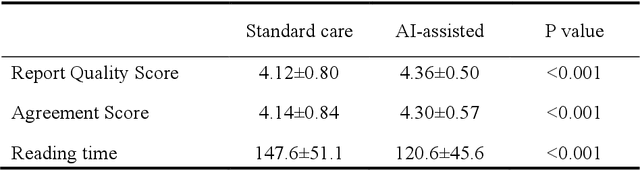
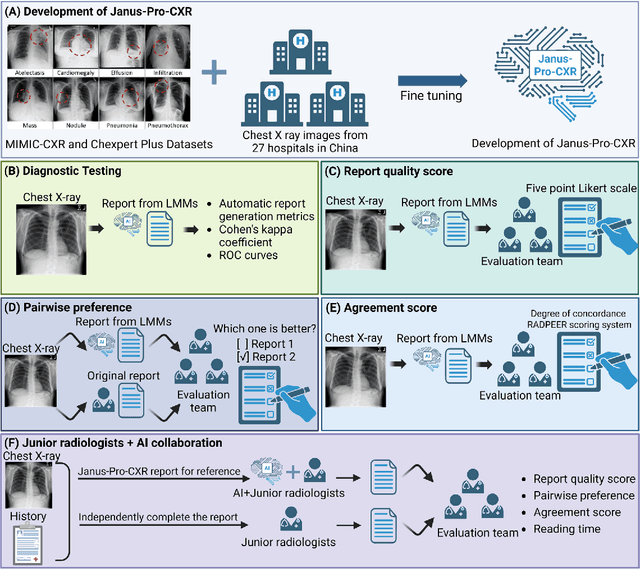
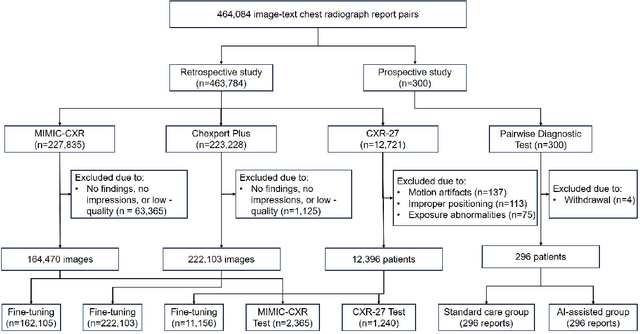
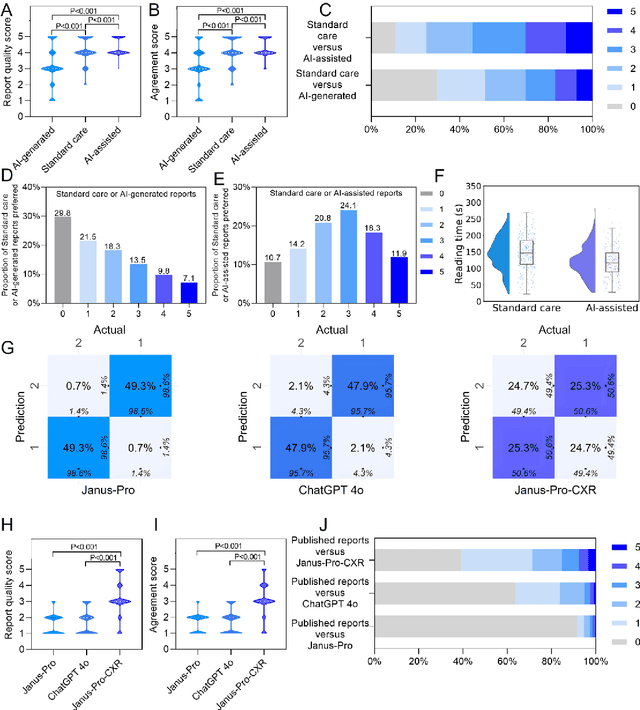
A global shortage of radiologists has been exacerbated by the significant volume of chest X-ray workloads, particularly in primary care. Although multimodal large language models show promise, existing evaluations predominantly rely on automated metrics or retrospective analyses, lacking rigorous prospective clinical validation. Janus-Pro-CXR (1B), a chest X-ray interpretation system based on DeepSeek Janus-Pro model, was developed and rigorously validated through a multicenter prospective trial (NCT07117266). Our system outperforms state-of-the-art X-ray report generation models in automated report generation, surpassing even larger-scale models including ChatGPT 4o (200B parameters), while demonstrating reliable detection of six clinically critical radiographic findings. Retrospective evaluation confirms significantly higher report accuracy than Janus-Pro and ChatGPT 4o. In prospective clinical deployment, AI assistance significantly improved report quality scores, reduced interpretation time by 18.3% (P < 0.001), and was preferred by a majority of experts in 54.3% of cases. Through lightweight architecture and domain-specific optimization, Janus-Pro-CXR improves diagnostic reliability and workflow efficiency, particularly in resource-constrained settings. The model architecture and implementation framework will be open-sourced to facilitate the clinical translation of AI-assisted radiology solutions.
AdaTooler-V: Adaptive Tool-Use for Images and Videos
Dec 19, 2025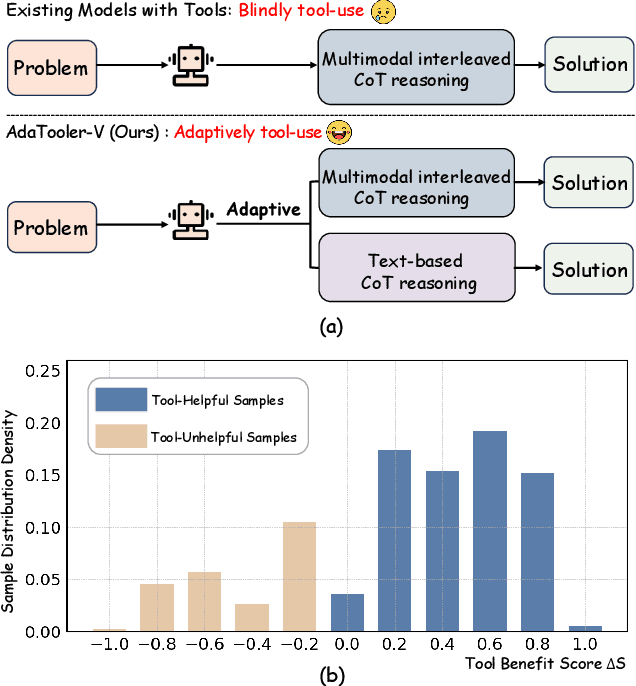
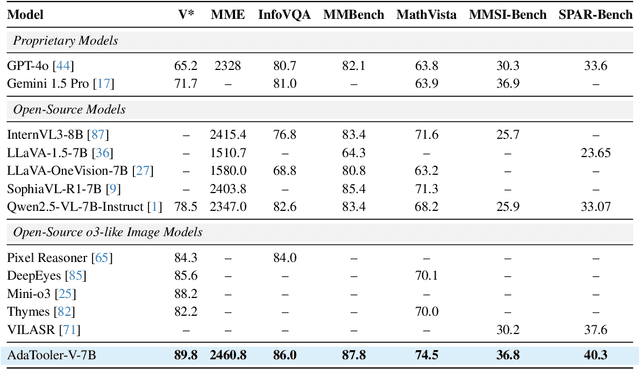
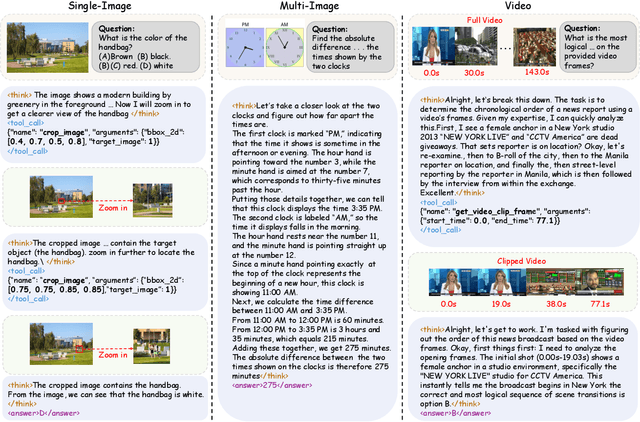
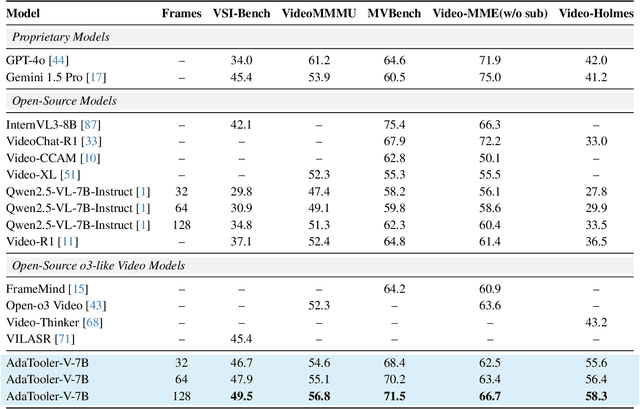
Recent advances have shown that multimodal large language models (MLLMs) benefit from multimodal interleaved chain-of-thought (CoT) with vision tool interactions. However, existing open-source models often exhibit blind tool-use reasoning patterns, invoking vision tools even when they are unnecessary, which significantly increases inference overhead and degrades model performance. To this end, we propose AdaTooler-V, an MLLM that performs adaptive tool-use by determining whether a visual problem truly requires tools. First, we introduce AT-GRPO, a reinforcement learning algorithm that adaptively adjusts reward scales based on the Tool Benefit Score of each sample, encouraging the model to invoke tools only when they provide genuine improvements. Moreover, we construct two datasets to support training: AdaTooler-V-CoT-100k for SFT cold start and AdaTooler-V-300k for RL with verifiable rewards across single-image, multi-image, and video data. Experiments across twelve benchmarks demonstrate the strong reasoning capability of AdaTooler-V, outperforming existing methods in diverse visual reasoning tasks. Notably, AdaTooler-V-7B achieves an accuracy of 89.8\% on the high-resolution benchmark V*, surpassing the commercial proprietary model GPT-4o and Gemini 1.5 Pro. All code, models, and data are released.